average time from first symptoms to a correct bipolar diagnosisgjennomsnittlig tid fra første symptom til riktig bipolardiagnose
Hirschfeld 2003 · Drancourt 2013Hidden bipolarity goes unnoticed. We're building the tool that uncovers it.Skjult bipolaritet blir oversett. Vi bygger verktøyet som avdekker den.
Bipolar II and soft bipolarity often hide — surfacing as depression, mixed states, subthreshold hypomania, anxiety or irritability, or mimicking other disorders. nexpsys is AI decision support that helps clinicians recognise the bipolar-spectrum pattern.Bipolar II og soft bipolaritet skjuler seg ofte — de viser seg som depresjon, blandede tilstander, subterskel-hypomani, angst eller irritabilitet, eller etterligner andre lidelser. nexpsys er AI-basert beslutningsstøtte som hjelper klinikere å gjenkjenne bipolarspektrum-mønsteret.
- Clinician-ledKlinikerstyrt
- LongitudinalLongitudinell
- Validated instrumentsValiderte instrumenter
The problemProblemet
When depression is not only depressionNår depresjon ikke bare er depresjon
Bipolar II, cyclothymia and subthreshold bipolarity are the hardest call in mood diagnostics. Patients present in depression, and euphoria is the exception — soft bipolarity shows up as dysphoric, irritable, anxious depression more often than an obvious high. So a recall-based interview misses it, and the result is often a lost decade on the wrong treatment model.Bipolar II, cyklotymi og subterskelbipolaritet er det vanskeligste feltet i stemningsdiagnostikk. Pasienten kommer i depresjon, og euforien er unntaket — soft bipolaritet viser seg oftere som dysfor, irritabel og urolig depresjon enn som en tydelig «high». Et hukommelsesbasert intervju overser den, og resultatet blir ofte et tapt tiår med feil behandlingsmodell.
initially misdiagnosed — most often as unipolar depressionfeildiagnostiseres først — oftest som unipolar depresjon
Hirschfeld 2003of depressed patients met strict DSM bipolar criteria (16%) — but showed bipolar features once course and family history were weighed (47%)av deprimerte pasienter møtte strenge DSM-kriterier for bipolaritet (16 %) — men hadde bipolare trekk når forløp og familiehistorie ble vektet (47 %)
Angst 2011 (BRIDGE)of the time bipolar II patients spend in clear hypomania — vs ~50% depressed. Most of the illness sits below the surface.av tiden tilbringer bipolar II-pasienter i klar hypomani — mot ~50 % i depresjon. Det meste av sykdommen ligger under overflaten.
Judd 2003- Recurrent depressionTilbakevendende depresjon
- Treatment-resistant depressionBehandlingsresistent depresjon
- Antidepressant-induced activationAktivering ved antidepressiva
- Early onset (before 25)Tidlig debut (før 25 år)
- Atypical features (hypersomnia, hyperphagia)Atypiske trekk (hypersomni, økt appetitt)
- Postpartum onsetDebut i barseltid
- SeasonalitySesongvariasjon
- Cyclothymic temperamentCyklotymt temperament
- Family history of bipolar IIFamiliehistorie med bipolar II
- Mixed featuresBlandede trekk
- ADHD / borderline overlapADHD-/borderline-forveksling
The question is rarely "is this bipolar?" but "how much bipolarity is in this depression?" Spørsmålet er sjelden «er dette bipolart?», men «hvor mye bipolaritet ligger i denne depresjonen?»
ApproachTilnærming
Four validators, not one checklistFire validatorer, ikke én sjekkliste
Since Robins & Guze (1970), psychiatric diagnosis has rested on four validators, not symptoms alone. An interview captures the first; soft bipolarity hides in the other three. nexpsys structures all of them.Siden Robins og Guze (1970) har psykiatrisk diagnostikk hvilt på fire validatorer, ikke symptomer alene. Et intervju fanger den første; soft bipolaritet skjuler seg i de tre andre. nexpsys strukturerer dem alle.
SymptomsSymptomer
Validated instruments (HCL-33, BSDS, CIDI 3.0, Bipolarity Index), not a single hypomania question.Validerte instrumenter (HCL-33, BSDS, CIDI 3.0, Bipolarity Index), ikke ett hypomani-spørsmål.
CourseForløp
Age of onset, episodicity, seasonality and duration over time — the longitudinal signature a snapshot can't catch.Debutalder, episodisitet, sesong og varighet over tid — den longitudinelle signaturen et øyeblikksbilde ikke fanger.
Family historyFamiliehistorie
Structured genetic history; a first-degree relative with bipolar II is high-specificity.Strukturert genetisk anamnese; en førstegradsslektning med bipolar II er svært spesifikk.
Treatment responseBehandlingsrespons
Activation or loss of response to antidepressants — a mood switch carried near ten-fold odds of bipolarity in BRIDGE (OR 9.6).Aktivering eller tap av respons på antidepressiva — et stemningsskift ga nær tidoblet odds for bipolaritet i BRIDGE (OR 9,6).
Angst 2011Biomarkers (planned)Biomarkører (planlagt)
Sleep, HRV, activity and circadian rhythm from wearables — an emerging fifth validator.Søvn, HRV, aktivitet og døgnrytme fra wearables — en framvoksende femte validator.
The platformPlattformen
From intake to a session-prep reportFra inntak til forberedelsesrapport
nexpsys structures what usually lives scattered across interviews, instruments, notes and course data — and gives patients time to answer carefully before the clinician reviews it.nexpsys strukturerer det som vanligvis ligger spredt i samtaler, skjema, journalnotater og forløpsdata — og gir pasienten tid til å svare grundig før klinikeren vurderer det.
Request demo accessBe om demotilgang Open demo loginÅpne demo-login A password-protected working demo of the patient-to-clinician flow: validated patient self-report, a structured clinician-rated assessment, and a combined session-prep report.En passordbeskyttet fungerende demo av pasient-til-kliniker-flyten: validert egenrapportering fra pasienten, en strukturert klinikervurdering, og en samlet forberedelsesrapport.
Open the mood journalÅpne stemningsjournalen Tempo is the longitudinal companion — a private daily or weekly journal of mood, energy and sleep that patients keep between visits. Its life-chart is exactly the course data the assessment asks for.Tempo er den longitudinelle følgesvennen — en privat daglig eller ukentlig journal for stemning, energi og søvn som pasienten fører mellom konsultasjonene. Livskurven er nettopp de forløpsdataene vurderingen etterspør.
Structured intakeStrukturert inntak
Digital history before the consultation — onset, episodes, mixed symptoms, treatment response — answered calmly in advance, not on the spot.Digital sykehistorie før konsultasjonen — debut, episoder, blandede symptomer, behandlingsrespons — besvart i ro og mak på forhånd, ikke på sparket.
Validated instrumentsValiderte instrumenter
HCL-33, BSDS, the CIDI 3.0 screen, TEMPS-A and the clinician-rated Bipolarity Index, scored together. We favour the HCL-33 and BSDS over the MDQ, which was built for bipolar I.HCL-33, BSDS, CIDI 3.0-screening, TEMPS-A og klinikerskåret Bipolarity Index, sett i sammenheng. Vi bruker HCL-33 og BSDS framfor MDQ, som ble laget for bipolar I.
Aiken 2015Longitudinal phenotypingLongitudinell fenotyping
Weekly low-burden mood charts, episode timelines and life-charting — the course over time, not a snapshot. About 1%/yr of unipolar diagnoses convert to bipolar.Ukentlige mood charts med lav byrde, episodetidslinjer og livsløpskartlegging — forløpet over tid, ikke et øyeblikksbilde. Rundt 1 %/år av unipolare diagnoser konverterer til bipolar.
Coryell 1995Digital biomarkers (planned)Digitale biomarkører (planlagt)
Sleep, HRV, activity and circadian rhythm from wearables, with consent — an objective complement to self-report, never the final word.Søvn, HRV, aktivitet og døgnrytme fra wearables, med samtykke — et objektivt supplement til selvrapportering, aldri fasiten.
Session-prep reportForberedelsesrapport
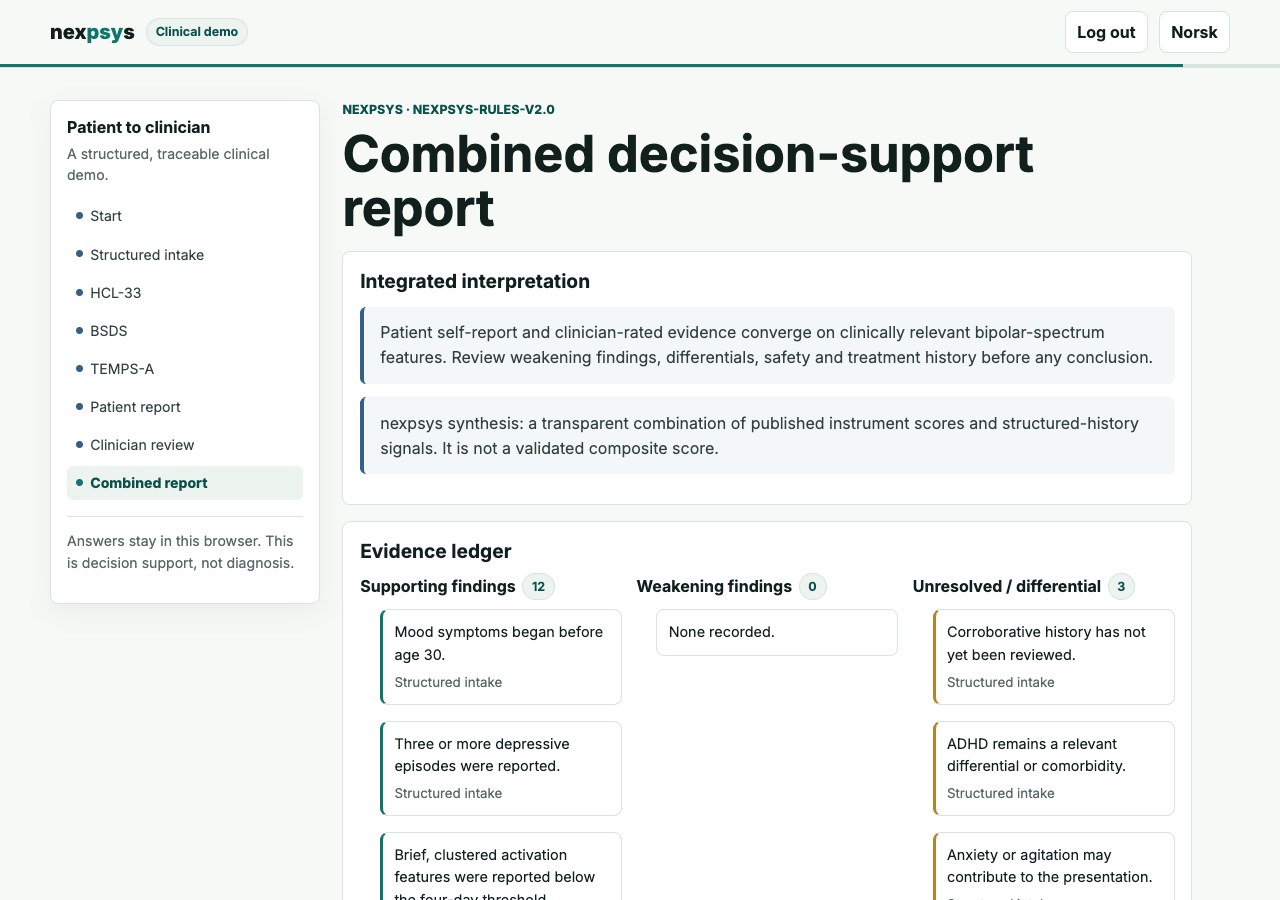
A structured, auditable synthesis: supporting and weakening findings, differential hypotheses, uncertainty, and the next questions — preparation for the consultation, not a verdict.En strukturert, etterprøvbar syntese: støttende og svekkende funn, differensialhypoteser, usikkerhet og neste spørsmål — en forberedelse til konsultasjonen, ikke en konklusjon.
Who it's forHvem
Built for those who assess and treat complex mood patientsBygget for dem som utreder og behandler komplekse stemningspasienter
PsychiatristsPsykiatere
A more complete, structured evidence base before diagnostic assessment.Et mer komplett, strukturert beslutningsgrunnlag før diagnostisk vurdering.
Outpatient clinicsDPS og poliklinikker
Structured pre-work and better prioritisation of further assessment.Strukturert forarbeid og bedre prioritering av videre utredning.
General practitionersFastleger
Systematic bipolarity screening before referral — better-targeted referrals.Systematisk bipolaritetsscreening før henvisning — mer treffsikre henvisninger.
Mood & rTMS clinicsMood- og rTMS-klinikker
Better diagnostic groundwork before treatment or neuromodulation.Bedre diagnostisk grunnarbeid før behandling eller nevromodulasjon.
Research & pilot partnersForsknings- og pilotpartnere
Structured phenotype data and cohorts; sparring on report format and validation.Strukturert fenotypedata og kohorter; sparring på rapportformat og validering.
ContactKontakt
Help improve psychiatric diagnosticsBidra til bedre psykiatrisk diagnostikk
We're looking for clinical sparring partners and pilot settings working with depression, bipolar II and complex differential diagnosis.Vi søker kliniske sparringspartnere og pilotmiljøer som arbeider med depresjon, bipolar II og kompleks differensialdiagnostikk.
Use the form to request access to the password-protected demo, or to discuss clinical workflow, report format and validation priorities.Bruk skjemaet for å be om tilgang til den passordbeskyttede demoen, eller for å diskutere klinisk arbeidsflyt, rapportformat og valideringsprioriteringer.
SourcesKilder
- Hirschfeld RMA et al. Perceptions and impact of bipolar disorder. J Clin Psychiatry 2003;64(2):161-174.
- Drancourt N et al. Duration of untreated bipolar disorder. Acta Psychiatr Scand 2013;127(2):136-144.
- Angst J et al. Undiagnosed bipolar disorder in major depression: the BRIDGE study. Arch Gen Psychiatry 2011;68(8):791-799.
- Judd LL et al. Long-term weekly symptomatic status of bipolar II disorder. Arch Gen Psychiatry 2003;60(3):261-269.
- Robins E, Guze SB. Establishment of diagnostic validity in psychiatric illness. Am J Psychiatry 1970;126(7):983-987.
- Parker G et al. hypomania duration, n=501, in Bipolar II Disorder, 3rd ed., Cambridge 2019; Angst J et al. 2003 Zurich cohort.Parker G et al. hypomania duration, n=501, in Bipolar II Disorder, 3rd ed., Cambridge 2019; Angst J et al. 2003 Zürich-kohorten.
- Aiken CB, Weisler RH, Sachs GS. The Bipolarity Index. J Affect Disord 2015;177:59-64.
- Coryell W et al. Long-term stability of polarity distinctions in the affective disorders. Am J Psychiatry 1995;152(3):385-390.
- Akiskal HS et al. TEMPS-A. J Affect Disord 2005;85:3-16.